In the current information age, asymmetrical cryptography is widely used to protect information and financial transactions such as cryptocurrencies. The loss of private keys can have catastrophic consequences; therefore, effective MFA schemes are needed. In this paper, we focus on generating ephemeral keys to protect private keys. We propose a novel bit-truncation method in which the most significant bits (MSBs) of response values derived from facial features in a template-less biometric scheme are removed, significantly improving both accuracy and security. A statistical analysis is presented to optimize an MFA comprising at least three factors: template-less biometrics, an SRAM PUF-based token, and passwords. The results show a reduction in both false-reject and false-acceptance rates, and the generation of error-free ephemeral keys.
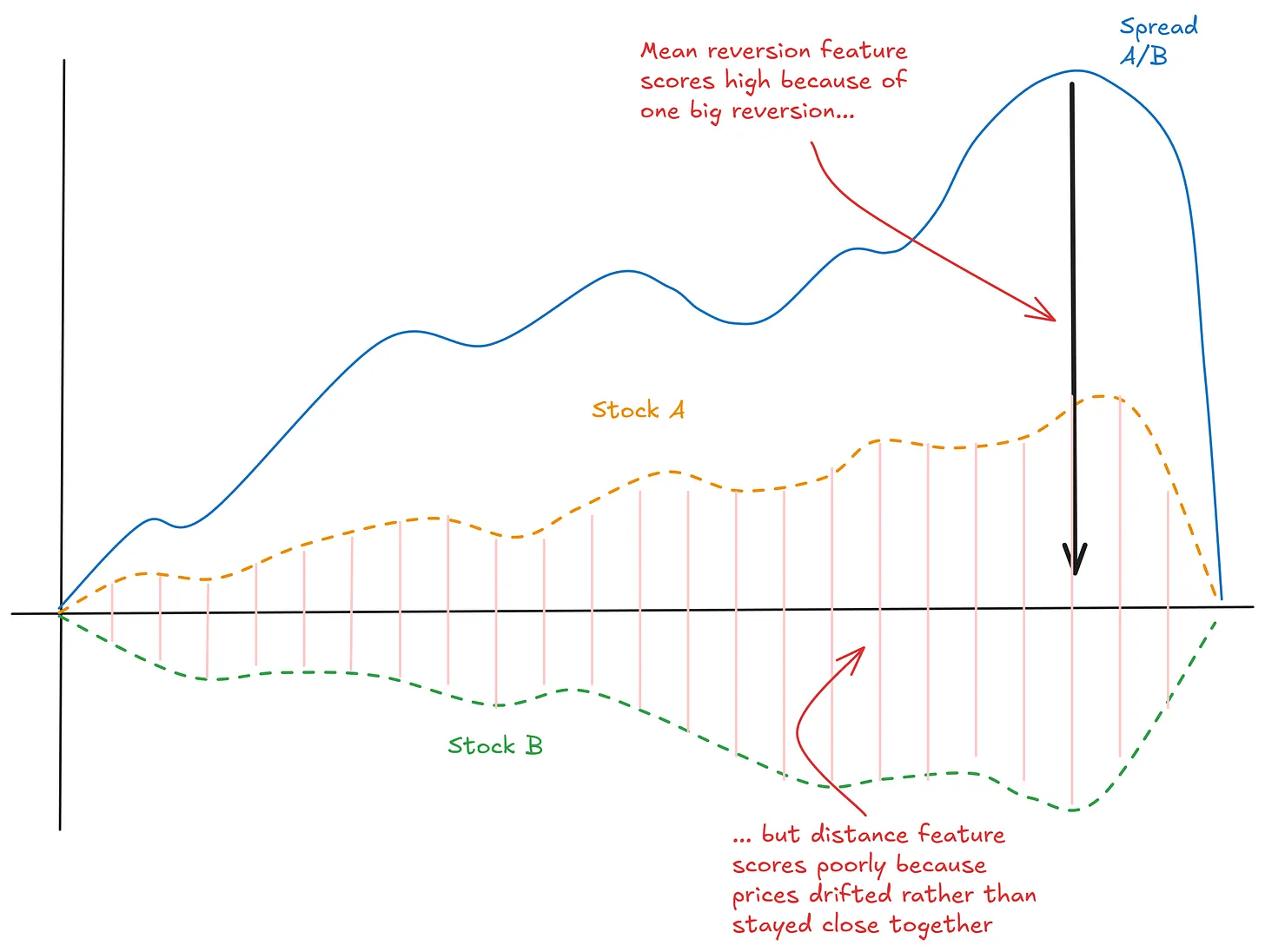
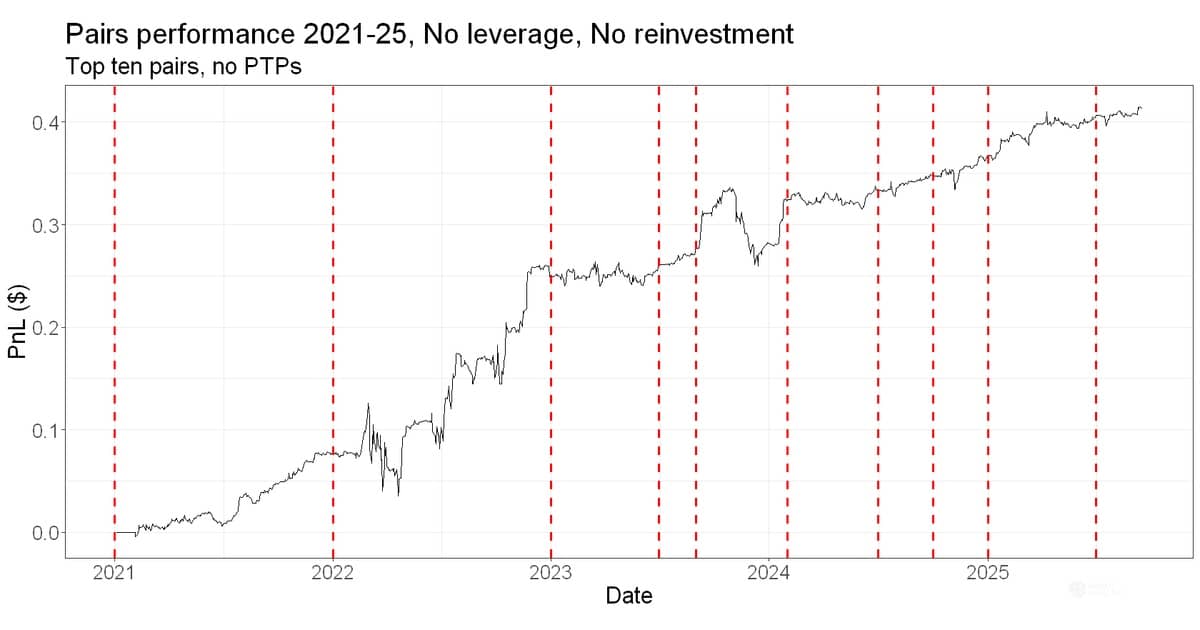
Part 3 of a series on Statistical Arbitrage for Independent Traders Previously: In the last article, we built up a conceptual understanding of universe selection: how to find pairs that diverge and converge in a tradeable way. We talked about measuring the thing you actually care about directly, rather than reaching for statistical tests like ... Read more The post The Winter of our Pairs Trading Discontent: Problems, limitations, frustrations appeared first on Robot Wealth .
Multi-horizon price forecasting is central to portfolio allocation, risk management, and algorithmic trading, yet deep learning architectures have proliferated faster than rigorous financial benchmarks can evaluate them. This study provides a controlled comparison of nine architectures (Autoformer, DLinear, iTransformer, LSTM, ModernTCN, N-HiTS, PatchTST, TimesNet, and TimeXer) spanning Transformer, MLP, CNN, and RNN families across cryptocurrency, forex, and equity index markets at 4-hour and 24-hour horizons. A total of 918 experiments were conducted under a strict five-stage protocol including fixed-seed Bayesian hyperparameter optimization, configuration freezing per asset class, multi-seed retraining, uncertainty aggregation, and statistical validation. ModernTCN achieves the best mean rank (1.333) with a 75 percent first-place rate, followed by PatchTST (2.000). Results reveal a clear three-tier ranking structure and show that architecture explains nearly all performance variance, while seed randomness is negligible. Rankings remain stable across horizons despite 2 to 2.5 times error amplification. Directional accuracy remains near 50 percent across all configurations, indicating that MSE-trained models lack directional skill at hourly resolution. The findings highlight the importance of architectural inductive bias over raw parameter count and provide reproducible guidance for multi-step financial forecasting.
The 2025 ASQ Customer Experience Awards show airports outperforming other industries as passenger satisfaction continues to rise Montreal, 24 February 2026 – Airports worldwide are outperforming other industries in customer experience, with passenger satisfaction continuing to rise, according to the 2025 ASQ Customer Experience Awards announced today by Airports Council International (ACI) World, in partnership with Gold sponsor SITA.…
Previously: A Tale of Two Prices (the core idea of stat arb) Last time we established that stat arb is really about betting on divergence/convergence behaviour continuing. Two things that have historically moved together come apart, and you bet on them coming back together. Remember the forced flows example, some fund or whatever having to ... Read more The post Moneyball: Finding Undervalued Pairs Using Unconventional Metrics appeared first on Robot Wealth .
Part 1 of a series on Statistical Arbitrage for Independent Traders. It was the age of wisdom, it was the age of foolishness… I’ve seen heaps of stuff published online about stat arb lately. Some genuinely good takes. And some other material that, while academically interesting, isn’t particularly useful for people like me and the ... Read more The post A Tale of Two Prices appeared first on Robot Wealth .
The past decade has witnessed the burgeoning and continuous development of blockchain and its applications. Besides various cryptocurrencies, an industry that has quickly embraced this trend is gaming. Thanks to the support of blockchain, games have started to incorporate non-fungible tokens (NFTs) that can enable a new gaming model, play-to-earn (P2E), which incentivizes users to participate and play. While recent studies looked at several NFT games qualitatively and individually, an in-depth understanding is still missing, particularly on how the P2E model has transformed traditional games. In this work, we set to conduct a measurement study of NFT games, aiming to gain a comprehensive understanding of the effectiveness of P2E in practice. For this purpose, we collect and analyze relevant NFT transaction data from the underlying blockchain (e.g., Ethereum) of 12 games, supplemented with various data scraped from their websites. Our study shows that (1) a few top wallets control unproportionally high percentage of NFTs, and the majority of wallets own only one or two NFTs and do not actively trade; (2) promotion events do boost the trade amount and the NFT price for some games, but their effect does not sustain; and (3) few players actually earned a profit, and players in 9 out of 12 games who traded NFTs have a negative profit on average. Motivated by these findings, we further investigate effective incentive mechanisms based on game theory to improve the trading profits that players can earn from these NFT games. Both modeling and simulation results confirm the effectiveness of the proposed incentive mechanism.
Cryptocurrency markets exhibit pronounced momentum effects and regime-dependent volatility, presenting both opportunities and challenges for systematic trading strategies. We propose AdaptiveTrend, a multi-component algorithmic trading framework that integrates high-frequency trend-following on 6-hour intervals with monthly adaptive portfolio construction and asymmetric long-short capital allocation. Our framework introduces three key innovations: (1) a dynamic trailing stop mechanism calibrated to intra-day volatility regimes, (2) a rolling Sharpe-ratio-based asset selection procedure with market-capitalization-aware filtering, and (3) a theoretically motivated asymmetric 70/30 long-short allocation scheme grounded in the empirical positive drift of crypto markets. Through extensive out-of-sample backtesting across 150+ cryptocurrency pairs over a 36-month evaluation window (2022-2024), AdaptiveTrend achieves an annualized Sharpe ratio of 2.41, a maximum drawdown of -12.7%, and a Calmar ratio of 3.18, significantly outperforming benchmark trend-following strategies (TSMOM, time-series momentum) and equal-weighted buy-and-hold portfolios. We further conduct rigorous robustness analyses including parameter sensitivity, transaction cost modeling, and regime-conditional performance decomposition, demonstrating the strategy's resilience across bull, bear, and sideways market conditions.
Around three quarters of Bitcoin transactions take place off-chain. Despite their significance, the vast majority of the empirical literature on cryptocurrencies focuses on on-chain transactions. This paper presents one of the first analysis of both on- and off-chain demand- and supply-side factors. Two hypotheses relating on-chain and off-chain demand and supply drivers to the Bitcoin price are tested in an ARDL model with daily data from 2019 to 2024. Our estimates document the differential contributions of on-chain and off-chain drivers on the Bitcoin price. Off-chain demand pressures have a significant impact on the Bitcoin price in the long-run. In the short-run, both demand and supply drivers significantly affect the Bitcoin price. Regarding transactions on the blockchain, only on-chain demand pressures are statistically significant - both in the long- and short-run. These findings confirm the dual nature of the Bitcoin price dynamics, where also market fundamentals affect the Bitcoin price in addition to speculative drivers. Bitcoin whale trading has less significant impact on price in the long-run, while is more pronounced contemporaneously and one-period lag.